
No. 65
November 9, 2026

Anniversary of Infamous Balfour Declaration
• Steadfast Palestinian Resistance
• Britain Must Be Held Accountable!
From the River to the Sea, Palestine Will Be Free
Resistance in Europe and Around the World
Iran
• Iranians Wage All-Sided Struggle in Defence of Sovereignty
• Transformation of Iran's Military Doctrine
• Iran's Underground Weapons Infrastructure
Lebanon
• Resistance Will Continue as Long as Occupation Persists
Yemen
• Armed Forces Target Strategic Sites in Saudi Arabia
Anniversary of Infamous Balfour Declaration
Steadfast Palestinian Resistance
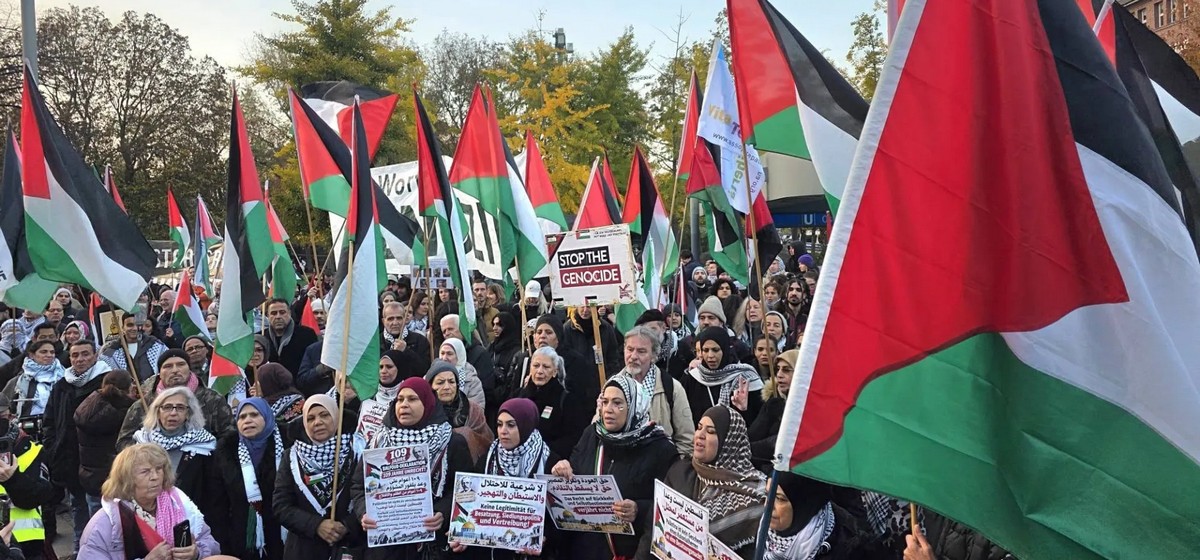
Rally in Germany, November 7, 2026 marks 109th anniversary of
the Balfour declaration.
On the 109th anniversary of the infamous Balfour Declaration, the
Palestinian Resistance Movement Hamas reiterated the Palestinian
people's adherence to their land, rights, and holy sites, pledging to
continue the struggle for liberation and return. Hamas called for
strengthening Palestinian national unity and effective international
action, including prosecuting Israeli war criminals. Peoples worldwide
continue to stand with the resistance and demand an end to the
U.S./Israeli genocide, the charging of war criminals from both countries
and holding those complicit, like Canada and Britain, accountable.
In a statement released on November 2, Hamas said that the Israeli occupation's crimes and colonial schemes would fail to erase the Palestinian people's national identity or undermine their inalienable historical rights.
Hamas affirmed that this year's anniversary of the Balfour Declaration comes amid an escalation in Israeli aggression and crimes across the Gaza Strip, the West Bank and occupied East Jerusalem.
"In the absence of international action, Palestinians in the Gaza Strip continue to face a worsening humanitarian crisis amid ongoing genocide, while displacement and settlement expansion continue to escalate in the West Bank and Jerusalem in violation of international law," Hamas said.
Hamas added that "the 109th anniversary of the Balfour Declaration marks one of the greatest injustices in modern history, when the British government issued a declaration that gave what it did not own to those who had no right to it."
Hamas emphasized that the colonial mindset continues to govern Israeli policies, pointing to the ongoing killings, blockade, starvation and displacement affecting Palestinians in Gaza, as well as in cities, towns and refugee camps across the West Bank.
The Movement stressed that "these crimes are imprescriptible and will remain a testament to the terrorism of the occupation and its supporters."
Hamas continues to demand the Israeli government halt its crimes and denounced its leaders as war criminals. The resistance movement is undaunted in developing the struggle for the right of return and the full liberation of Palestine.


Vigil in Gaza for prisoners marks anniversary of Balfour
Declaration

Meeting in Tyre, Lebanon on anniversary of Balfour Declaration

Cultural event at the Nar-el-Barad refugee camp in Lebanon
marks Balfour Declaration Anniversary

Demonstration in Manchester, England marks anniversary of
Balfour Declaration, November 7, 2026
Recent Actions in Canada Stand with Palestine
Ottawa


October 31, 2026
Edmonton


October 25, 2026


October 26, 2026
Vancouver


October 31, 2026; November 7, 2026
(Palestine Information Centre. Photos: TML, fimed, @613palestine, @mvupalestine)

Britain Must Be Held Accountable!
From the River to the Sea, Palestine
Will Be Free

"Red Line" Demonstration of 200,000 in Amsterdam, Netherlands,
November
8, 2026 stands with Palestine and demands an end to the
genocide.
On the anniversary of the British empire's infamous colonial Balfour Declaration ostensibly proclaiming the right to a 'Jewish national home' in colonized Palestine, Samidoun Palestinian Prisoner Solidarity Network renews the demand for justice and accountability from the British state and its international allies as we mark more than a century of Palestinian resistance, struggle and revolution. One hundred and nine years after the declaration was signed, British complicity in the Zionist project is as clear as ever, whether through RAF reconnaissance missions assisting the genocide in Gaza, the housing of Israeli weapons manufacturers on British soil, or the widespread repression of those most committed to the Palestinian struggle and the designation of Palestine Action as a terrorist organization.
 The
Balfour Declaration, the letter from British Foreign Secretary
and
former Prime Minister Alfred Balfour to Walter Rothschild, a
prominent
Zionist leader in Britain in 1917, pledged to support a
"national home
for the Jewish people" in Palestine, at the time part of the
Ottoman
Empire. The
Balfour Declaration formed part of the imperial and colonial
plans in
the region, along with the Sykes-Picot agreement which laid out
the
colonial division of the Arab world for the benefit of Britain
and
France. Support for the Zionist project fit firmly into this
category.
Theodor Herzl himself
appealed to Cecil Rhodes for support for the Zionist project in
Palestine as "something colonial," while Chaim Weizmann pledged
to
"form a very effective guard for the Suez Canal." Zionism is,
and has
always been, racism, colonialism and imperialism.
Balfour himself was a prime example of a racist, supremacist colonial statesman of the British Empire. As Irish Secretary, he oversaw the Mitchelstown Massacre, where protesting tenants were shot and killed, and opposed Irish Home Rule. In South Africa, he was an active advocate for the failing British imperial offensive during the Second Boer War. In the House of Commons, he made the argument that the 'disenfranchisement' of native black South Africans was justified because "the white and black races are not born with equal capacities." Far from an advocate of the rights of Jews facing oppression and hatred in Europe, Balfour as Prime Minister in 1905 passed the Aliens Act, specifically intended to exclude Eastern European Jews from Britain.
The declaration became a cornerstone of British policy during the Mandate period and helped create the conditions for the establishment of Israel in 1948. Under British colonial administration, Zionist institutions and military organizations expanded, while Palestinian political resistance was increasingly met with repression. British authorities facilitated the growth of the Zionist project, including through military cooperation, training and the arming of forces that would later play a central role in the establishment of Israel.
The consequences became catastrophic for the Palestinian population during the Nakba of 1948, when approximately 750,000 Palestinians were expelled or forced to flee their homes. Hundreds of Palestinian villages and towns were depopulated or destroyed, and the majority of the Palestinian people were forced to become refugees. The Nakba was not an isolated historical event disconnected from earlier British policy. It must be understood within the broader historical process of colonial intervention, land dispossession and the systematic denial of Palestinian political rights.
The history of Palestine since 1917 is not merely a history of colonial expansion and dispossession. It is also a history of persistent resistance. From popular demonstrations and mass uprisings to political organizing and international solidarity, successive generations of Palestinians have challenged colonial domination. The revolts of 1922 and 1929, the Great Palestinian Revolt of 1936-1939 and the resistance surrounding the Nakba and subsequent decades form part of a continuous struggle for freedom and self-determination.
The Great Palestinian Revolt was met with devastating British repression. Thousands were imprisoned, homes were demolished and resistance leaders were executed. British authorities relied on collective punishment, military force and mass detention to suppress Palestinian resistance. These practices established a legacy of repression that would continue under Israeli rule: indeed the Zionist regime's practice of 'administrative detention' -- imprisonment without charge or trial, on the basis of a 'secret file' denied to both the detainee and their lawyer -- has its origins in the British Mandate. To this day, it is routinely used to target Palestinians, especially community leaders, activists, and influential people in their towns, camps and villages. The policy of demolishing Palestinian prisoners' homes – and those of their families – was also carried over to the Zionist colonial entity from British "emergency laws."
This year saw the Zionist entity approve the 'execution law' targeting Palestinian prisoners. This law seeks to legitimize the ongoing colonial practice of assassinating prisoners, whether through torture, abuse, or the denial of medical treatment. These prisoners are at the forefront of the Palestinian resistance, and are often themselves the leaders of the liberation movement, and their assassinations are an attempt to strangle the Palestinian people and their will to resist. The hangman's noose is specified in the text of the law. Much like 'administrative detention,' this law recalls the British execution policy against Palestinians in resistance. Fouad Hijazi, Mohammad Jamjoum, and Ataa al-Zeer, three Palestinian revolutionary prisoners executed by the British in 1930, became icons of the prisoners' movement, while the song in their honour, "From Akka Prison," has remained one of its anthems for nearly a century.
Britain has never confronted nor acknowledged its historical responsibility for the colonization of Palestine. The British government issued the Balfour Declaration, administered the Mandate, facilitated the expansion of the Zionist project and violently suppressed Palestinian resistance. The British have remained complicit in Zionist occupation and genocide in the 109 years since the declaration; British armed forces have provided direct support to the genocidal crimes committed by the Zionist entity in Gaza since Al-Aqsa Flood; today Britain hosts many Israeli arms factories and the Israeli arms industry is deeply entwined with the British military; Britain has carried out a campaign of repression against those who stand up in solidarity with Palestine, culminating in the designation of Palestine Action as a terrorist organization in 2025.
 In 2026, four Palestine Action
militants were sentenced to a
combined total of more than 25 years in prison, after a judge
ruled
that they could be treated as terrorists, for causing serious
damage to
an Israeli arms factory in Bristol in 2024. There are dozens of
prisoners for Palestine and
actionists on trial in British courts for taking action against
Zionist
and imperialist arms factories, as well as multiple Palestinians
jailed
in British jails at the behest of foreign extradition requests
built on
"Israeli" intelligence. Since the proscription of Palestine
Action,
more than 3,000
people have been arrested for expressing their support for the
group,
and this week, on 4-5 November, the British Supreme Court will
hear the
legal challenge to the proscription. It should be noted that
Palestine
Action militants destroyed a portrait of Arthur Balfour in
Trinity
College, Cambridge
in 2024, and abducted two busts of Chaim Weizmann from the
University
of Manchester, confronting both the symbolism and the material
reality
of British responsibility and complicity in Zionist crimes.
Of course, the proscription of Palestine Action is built upon the framework of the proscription of Palestinian resistance organizations and many regional resistance organizations: Hamas, Palestinian Islamic Jihad, Hezbollah, and the Islamic Revolutionary Guard Corps of Iran, among others. Under British law -- as has been vividly applied in the case of Palestine Action -- expressing mere verbal support for a proscribed organization is itself a crime punishable by years in prison. Not only does Britain bear responsibility for the Zionist genocidal project in Palestine historically and at present, it criminalizes even verbal expressions of support for those giving their lives to bring the genocide to an end, regardless of the fact that these are large, mass political movements and even state institutions.
The Balfour Declaration remains an enduring symbol of British colonial responsibility for the dispossession of the Palestinian people. More than a century later, Britain has yet to meaningfully acknowledge its role. As an imperialist power, today a partner of the United States, it continues to be deeply supportive of the Zionist project, while participating in the targeting of Iran, Yemen and Lebanon. The history of the Balfour Declaration is therefore not simply a chapter in Britain's colonial past, but a continuing representation of its imperialist reality. It is part of an ongoing struggle, connecting the resistance of Palestinians under the British Mandate to the prisoners, refugees, communities and the resistance confronting Zionist colonialism today.
From the gallows of Akka prison to the prisons of the present, from the villages destroyed in the Nakba to the communities resisting displacement today, the Palestinian struggle has endured across generations. As we mark 109 years since Balfour's illegitimate promise, we reaffirm our commitment to Palestinian prisoners and to the liberation of Palestine, from the river to the sea. A century of colonialism has not broken the Palestinian people's determination to resist, and no declaration, law or prison can extinguish their struggle for liberation and return.

The Popular Conference for Palestinians Abroad holds national meeting
in Istanbul, Türkiye, demanding that Britain apologize and provide
compensation for the damage done by the Balfour Declaration, November
2, 2026.
(November 2, 2026. Photos: World Riots, FIMED)
Resistance in Europe and Around the World
Ports Are Not for War! Dockworkers Continue
to Take Firm Stand
in Support of Resistance Against Aggression and Genocide

Bologna, Italy
On October 30 dockworkers staged strikes and demonstrations protesting the use of commercial ports for military purposes under the slogans Ports Are Not for War! and Workers Do Not Work for War! The dockworkers' actions also affirmed their stand that they will not handle arms being shipped to Israel. The dockworkers also expressed their support for the youth in action in Europe, joining the youth in fighting against war and for a bright future. As part of this, alongside dockworkers' strikes, rallies in support of Palestine were organized in many cities.
 Hundreds of thousands of people participated in actions in 113 ports
in 22 countries on five continents. In Europe dockworkers struck in
France, Spain's Basque Country, Italy, Greece, Cyprus, Denmark, Sweden
and Germany. Dockworkers struck in India, Türkiye and Morocco and in
Oakland, California
the International Longshore and Warehouse Union Local 10 joined the day
of action. In addition to the dockworkers' work stoppages dozens of
unions and federations in other sectors carried out actions in support
and solidarity around the world.
The No Harbour for Genocide campaign noted that several ports where there were strikes, including Genoa, Livorno and Gioia Tauro in Italy, Marseille in France, Piraeus in Greece and Tangier in Morocco, have been linked to weapons shipments to Israel. The campaign tracked 315 shipments of components for Israel's largest arms manufacturer, Elbit Systems, that passed through 56 commercial ports in 29 countries between August 2025 and September 2026.
In Italy, the Unione Sindacale di Base (USB) called a 24-hour national general strike which took place despite Transport Minister Matteo Salvini's ordering transport workers back to work. The strike was against both rising living costs and arms shipments and the USB estimated that 1.5 million people participated. Dockworkers received support from other workers and youth who joined the mobilization with banners and pickets.
In Greece, a massive rally took place in the port city of Piraeus where workers were on strike. Demonstrators unfurled a large banner near the port bearing the message: Workers Do Not Work for War.

The mobilization also stalled operations at the port of Thessaloniki, where more than 200 container trucks were reportedly brought to a standstill, and workers at the port of Patras also struck.
In France, hundreds of workers at the port of Fos-sur-Mer, west of Marseille, joined the mobilization under banners opposing war and the militarization of ports.
Young dockworkers and apprentices in Germany staged a solidarity gathering and demonstration at the Port of Hamburg.
Sweden's Port Workers' Union voiced opposition to the militarization of European ports and warned against the use of security legislation to restrict trade union activities and put pressure on workers.
In Denmark, trade unions and federations also expressed solidarity, saying dockworkers should not be made complicit in wars or war crimes through the transport of weapons.
Dockworkers and seafarers in a dozen ports in India joined the international action, calling for ports of peace and jobs with dignity.

"No More Weapons in the Port of Genoa"
Speaking about the significance of the dockworkers' actions the Collettivo Autonomo Lavoratori Portuali which organized the actions in Genoa, Italy stated "The young people are clearly telling us that they have no intention of giving up their lives to the wars of governments and masters. They are telling us that they do not want a future made of rearmament, militarization, and precariousness. They want schools, health care, decent wages, rights, and the opportunity to build a life for themselves. They want a future, not a war!
"And we will be by their side. Not just in words, but in the squares, in the ports, in workplaces, and in every space where it will be necessary to organize struggle and build opposition. We will not take a step back. We will not leave the young people alone who are choosing to raise their heads and fight for their future."
In Gaza, Palestinians gathered at the fishermen's port west of Gaza City on the eve of the dockworkers' day of action in solidarity with dockworkers and against the use of ports to support Israel's war on Gaza. The head of the General Union of Fishing and Marine Production Workers pointed out that Palestinian fishermen have been prevented from accessing the sea for more than three years and that they must be allowed to return.
France

Le Havre

Fos-sur-Mer
Italy
 Genoa

Cuneo

Turin


Bologna

Carrara

Liguria

Rome

Bari
Greece

Piraeus

Patras
Cyprus

Slovenia


(Photos: European Dockworkers Council, USB, USB Rome, USB Bologna, USB Piedmont, AA, PAME, I. Moss)
Iran
Iranians Wage All-Sided Struggle
in Defence of Sovereignty

"National Day of Struggle Against Global Arrogance," reaffirming
support for regional Resistance movements and opposition to U.S.
domination was held November 4, 2026. Rallies were held across
the
country, photo above is from Tehran.
Iran remains steadfastly committed to engaging in a negotiated peace with the United States if possible, while it remains fully mobilized and prepared to defend itself yet again militarily, if necessary.
On October 28 the leader of the Islamic Revolution Ayatollah Seyyed Mojtaba Hosseini Khamenei called for fulfilling the conditions set by Iran for ending the war and bringing the current "neither war nor peace" situation to an end. Iran continues to insist that the basis for negotiations remains the Islamabad Memorandum of Understanding (MOU) the U.S. entered into in April as the framework for a negotiated settlement. The Islamabad MOU respects Iran's rights as a nation, as well as the rights of the Palestinians, Lebanese, Yemeni and other resistance movements in the region. The Ayatollah called on the President of Iran and all executive bodies to resolve problems in a manner which ensures the protection of national and regional security.
He ordered senior military commanders to ensure that any level or type of enemy threat is met with an "immediate, impactful, and geographically unrestricted response." He hailed the resoluteness of the Iranian people who rallied in public squares across Iran for eight months in defence of critical public infrastructure even while the U.S./Israeli bombs were falling. He also expressed his appreciation for "the intelligent steadfastness of the Resistance Front in various countries," describing the "unity of operational domains" as "a decisive factor with a strategic impact on shaping the new political and security order in West Asia."
Military leaders responded with concrete measures to ensure all preparations were in place for "immediate, impactful, and geographically unrestricted response" to any military aggression. Foreign Ministry spokesman Esmaeil Baghaei stated clearly: "The hit-and-run era is over."
For their part, the U.S. president and Department of War continue to threaten Iran with more aggression and even obliteration. On October 29, U.S. monopoly media sources reported that U.S. President Trump had just been briefed by the head of the U.S. military's Central Command (CENTCOM), the Secretary of War and the Pentagon Chief of Staff on "new military options for attacking Iran." This has been followed by open talk of a resumption of a large scale offensive, including plans to land U.S. troops on Iranian soil and speculation that the U.S. or Israel may resort to using nuclear weapons in an effort to destroy Iranian civilization.
 The Iranian people have
defied such threats time and time again. As
a result of the last two unprovoked U.S./ Zionist attacks on
Iran more
than 31.5 million Iranians registered in the Jan Fada
(Self-Sacrifice) campaign to defend the homeland. Participants
are
being integrated into
defence battalions, completing basic training and conducting
advanced
training in various ground, air and naval fields, in preparation
for
comprehensive defence.
Reports confirm that in October more than 300,000 people participated in drills in Tehran and across the country. Thirty thousand participated in Chaharmahal and Bakhtiari province alone. The head of this mobilization said, "Jan Fada is the largest popular campaign in the history of the world's wars, and nowhere do we find a nation participating in this way and eagerly declaring its presence for combat in all fields."
"This million-strong movement will bend the enemy's back," he said.
Iran's President Masoud Pezeshkian says the country is not in a "neither war nor peace" situation, but is instead engaged in a full-scale economic war imposed by the U.S.
In a video conference with officials of the northern province of Gilan on Thursday, Pezeshkian said that there is a full-scale economic war against Iran, adding that the enemy has closed the maritime routes and has also created restrictions on land routes.
He also said that the government is trying its best to keep the country standing firm against all pressures and to be able to resolve the problems to a great extent.

Mass rally in Tehran, September 18, 2026 kicked off the Jan
Fada campaign.
Military Front
So far, each attempt made by the U.S. military to probe Iranian air defences in preparation for renewed military aggression has failed. For example, on November 3, Iran's Islamic Revolutionary Guard Corps (IRGC) said its air defence forces had intercepted and shot down two U.S.-made LUCAS drones over the southern port city of Bandar Khamir. Also that day, the IRGC announced it had intercepted and destroyed a U.S. MQ-9 Reaper drone over the eastern Strait of Hormuz, using a new air defence system. This is the 55th such "hunter-killer" drone it has shot down. The IRGC announced on November 6 it had captured two more U.S. MQM-170 reconnaissance drones over waters south of Qeshm Island in the Strait of Hormuz, bringing the total number of such drones seized in recent days to six. The MQM-170 is designed to allow U.S. military crews to train for aerial attacks without putting manned aircraft at risk. The drones were brought down using advanced electronic warfare systems, highlighting the growing role of electronic warfare capabilities in Iran's efforts to counter aerial surveillance. The IRGC also announced that day that it had shot down its 16th U.S. MQ-1 Predator drone.
Furthermore, the Strait of Hormuz remains closed despite all the efforts by the U.S. to counter Iran's restriction on oil deliveries through the Strait. The U.S. is actively encouraging smuggling operations using smaller vessels and ship-to-ship transfers of smuggled oil to larger vessels once beyond the Strait. On November 2, the IRGC Navy said 11 different oil tankers violating the closure have caught fire or sunk since the head of CENTCOM visited the region on October 25. Iran permits other ships transit with Iranian authorization. Nonetheless, UK Maritime Trade Operations (UKMTO) said shipping traffic through the Strait remained approximately 70 per cent below pre-war levels. On November 8, the IRGC announced that three tankers had exploded and caught fire in the Strait. They had entered restricted routes with their navigation and identification systems switched off. Vessels using unauthorized routes risk striking naval mines.
The energy crisis caused by the U.S./Zionist aggression against Iran led the U.S. and global institutions under its control, such as the G7 and the International Energy Agency (IEA), to announce in October the release of some 330-400 million barrels of emergency oil reserves, allegedly to stabilize international markets. On October 29 alone, the U.S. released 172 million barrels of crude oil while the other G7 countries agreed in early October to release up to 100 million barrels of diesel and crude.
Global oil consumption is estimated at roughly 100 million barrels per day. The emergency release was seen as a failed manoeuvre to influence the result of U.S. mid-term elections. Reports also indicate that capacity of the U.S. and the genocidal G7 warmongers to manipulate the situation with further releases of strategic reserves is limited. Global emergency oil capacity and reserves are just over 1 billion barrels in government-controlled public stocks across IEA member countries.
The U.S. also continues to pressure neighbouring countries to participate in implementing economic sanctions and to blockade trade routes for Iran. Reports indicate that Iraq was forced, under threat of the withholding of payments for Iraqi oil or transfers from Iraqi national funds which are held in the U.S., to indefinitely close the Al-Sheeb crossing into Iran in the last week of October.
Iraqi truck drivers, transport workers and residents have since been gathering on roads outside the border crossing and blocking oil transportation routes, demanding a reopening of the Iran border crossing. Iraq issued an arrest warrant for the head of the Maysan Provincial Council over his active role in calling for civil disobedience unless the government reopened the Al-Sheeb border crossing with Iran.
Pakistan too was pressured by the U.S. to close its border crossing with Iran at Gabd-Rimdan. The Pakistani newspaper Dawn reported on October 25 that the U.S. is trying to strangle Iran economically through a land and sea blockade. The border was re-opened by Pakistan on November 2 after one week, with Pakistan announcing it will continue bilateral trade with Iran in accordance with international law and is not bound by unilateral sanctions imposed on Iran. Pakistani Foreign Ministry spokesperson Tahir Andrabi described economic pressure on Iran as part of the deadlock between Iran and the U.S., saying the issues should be addressed through diplomacy and dialogue.
On November 3, Iran confirmed it had received a letter sent by U.S. Vice President J.D. Vance delivered to General Mohsen Rezaei, Secretary of Iran's Supreme National Security Council, through Qatari mediators. Iranian Foreign Minister Abbas Araghchi said the letter proposed a "framework" for direct negotiations. He said that the U.S. pre-conditions, including that Iran's peaceful nuclear program must be placed on the table from the outset, were an unacceptable violation of Iran's rights as a nation.
A spokesperson for Iran's Foreign Ministry said Iran's demands in ongoing diplomatic efforts remain the same as those accepted by the United States under the Islamabad MOU, which the U.S. subsequently violated. He said the U.S. must first lift all sanctions imposed on Iran under the so-called "Economic Fury" operation following its breach of the Islamabad MOU, as well as implement commitments outlined in the agreement, including the release of Iran's frozen funds and assets.
 Contending
with Iran's firm resistance and the strong anti-war stand expressed in
the U.S. mid-term elections November 3, on November 8, U.S. President
Trump said that more aggression against Iran was "highly unlikely" if
Iran signs "a very strong agreement." He also said, as he has before,
that the U.S. would hit Iran "really hard," if he decided to.
Iranian Foreign Minister Araghchi said that Iran would "rain down hell" if further aggression is launched but reiterated that a diplomatic solution based on Iran's previously stated proposal is its priority. This proposal, issued at the end of October, states that Iran will reopen the Strait of Hormuz in an expedited timeline of two days, down from seven days previously proposed in September via Qatar, if the U.S. agrees to its conditions of ending the war on all fronts -- namely, unfreezing Iranian assets abroad, lifting sanctions on its oil sector and ending the U.S. naval blockade of Iranian ports.
Oman is also involved in negotiations. The U.S. recently sent the Sultan of Oman to China with a new initiative to mediate between Iran and the U.S. Furthermore, on October 27, Omani Foreign Minister Badr al-Busaidi, speaking at Cambridge University in Britain, called on the six Gulf countries -- Saudi Arabia, Bahrain, Kuwait, Qatar, the United Arab Emirates and Oman -- as well as Iraq and Iran, to unite under a single "non-aggression" security pact.
High-level delegations from Pakistan, Türkiye and Saudi Arabia also visited Tehran on October 26 for four-way talks with Iranian officials. British media reported that day that Gulf states are trying to develop a diplomatic deal to avert another U.S.-Iran war that involves the Strait of Hormuz, Yemen, and a new regional security framework,
Iranian President Masoud Pezeshkian said Iran was ready to deepen regional cooperation, resolve disputes, and harness countries' shared potential, calling for a unified stance to confront threats and aggression and strengthen security, stability and development across the region.
Iran's Supreme National Security Council Secretary Mohsen Rezaei said the four-party talks were "very good" and agreed that West Asia's security should be managed by regional states, without foreign intervention. The "results of the Iranian nation's resistance" are becoming more tangible "day by day," he said. The four countries said they would "continue the dialogue," and officials called it the first in an expected series of meetings, though no further date has been set for negotiations.
(Photos: Mehr, IRNA, Al Mayadeen)
Transformation of Iran's Military Doctrine

National Day of Struggle Against Global Arrogance rally, Tehran,
November 4, 2026
On November 1, Professor Mohammad Marandi, an expert in strategic affairs and part of the team negotiating with the U.S. before the U.S. sabotaged peace talks earlier this year, spoke on Al Mayadeen. Addressing the transformation of Iran's military doctrine, Marandi said recent statements by Seyyed Khamenei suggested that Iran is considering expanding the geographical scope and range of its response to aggression. He pointed to the possibility of extending missile capabilities and deploying long-range drones beyond Iran's borders, arguing that such measures could make military facilities and other targets further from Iranian territory accessible.
Marandi distinguished between changing Iran's defensive doctrine and expanding the nature of its retaliation, rejecting the interpretation that Iran is shifting from a defensive to an offensive military posture.
He explained that the nature of Iran's retaliatory assaults in response to aggression is going to change. Iran's response could expand in scope and targets selected, noting that Seyyed Khamenei had also referred to expanding the list of potential targets. He linked this development to changes in modern warfare, including the growing use of artificial intelligence and other technologies, which he said were increasingly being deployed to support Iran's military capabilities.
Marandi also argued that expanding the range of Iranian missiles and drones could force the U.S. to move its military assets further away from Iranian territory, making any future attack more difficult and costly. The U.S. presently has some 50,000 land-based troops in West Asia, with another 20,000 naval and amphibious troops also in the region, including forces based on two aircraft carrier groups. Another carrier group is set to arrive via East Asia in mid-November.
He recalled that during the first 40 days of the war Iran struck U.S. bases across the Persian Gulf region and the Israeli occupation regime. The U.S. subsequently moved its military assets further away, including shifting operations toward Jordan, which Iran also targeted.
The U.S. then moved its naval forces further from Iranian capabilities, Marandi said, arguing that extending the range of Iran's weapons would further complicate U.S. military operations.
"It makes attacking Iran more expensive. It makes it more difficult, more complicated, and it also decreases the number of airstrikes that can be carried out because of the sheer distance between the operational centres and Iran and the amount of refueling that has to take place during the operations," he said.
He also raised the possibility that Iran could target military bases beyond West Asia if they were used to launch attacks against the country, citing Diego Garcia in the Indian Ocean, site of a joint U.S.-UK military base, and military facilities in Europe as examples.
Marandi referred to statements by NATO Secretary General Mark Rutte about thousands of flights from European NATO countries supporting U.S. operations during the war, arguing that the vulnerability of these bases could complicate the ability of the U.S. to sustain military operations. "If those key bases are no longer secure, then that makes it all the more difficult for the United States," he said.
He added that Iran had previously imposed limitations on the range of its missiles as a confidence-building measure, suggesting that Iran could reconsider those restrictions. However, he clarified, he was speculating about any decision to remove the limitations.
Iran's Underground Weapons Infrastructure
In his November 1 interview on Al Mayadeen, Professor Mohammad Marandi addressed footage released by Iranian media showing underground military facilities and preparations involving missiles and drones, arguing that the images demonstrated the scale of Iran's weapons infrastructure.
He recalled that U.S. military officials had repeatedly claimed during the early stages of the war that Iran was running out of missiles and drones and that its weapons factories had been destroyed. The U.S. also presented graphs purporting to show a daily decline in Iranian launches, he said.
Far from it, Marandi argued that Iran's continued military activity reflected the scale of its underground production and storage capabilities, that "Iran's underground capabilities are enormous. Iran has underground factories, assembly lines, research and development centres."
He cited the Iranian army's presentation of an underground facility
producing Arash drones, noting that the drones had since been upgraded.
This drone has a range of up to 2,000 kilometres, and now carries a 150
kilogram (kg) warhead, up from 50 kg. He stated that the facility
represents one example of the country's broader underground military
infrastructure.
Marandi also pointed to Iran's satellite program as evidence of its technological capacity to develop missiles with ranges exceeding the limits Tehran had previously imposed.
He said Iran had historically restricted its missile range to approximately 2,000 kilometres, although he was not certain of the exact figure, and argued that the country's technological capabilities could allow it to extend that range if it chose to do so.
Marandi linked the possibility of expanding missile and drone ranges to Seyyed Khamenei's remarks about the absence of geographical limitations and the need to add new targets to Iran's list.
To be clear, he repeated that he is not privy to the relevant military decisions and was offering his own interpretation of the statements.
Lebanon
Resistance Will Continue as Long
as Occupation Persists
The head of Hezbollah's Executive Council Sheikh Ali Damoush said following the U.S. mid-term elections that a Democratic victory over U.S. President Donald Trump and the Republicans would not change Washington's hostile policy toward the peoples of the region. Stressing that successive U.S. administrations pursue the same strategic objectives regardless of their political affiliation, Sheikh Damoush said:
 "Democrats and Republicans adopt
the same hostile policy toward the peoples of our region."
He said U.S. objectives remain unchanged: dominating the region and its resources while ensuring continued support for the Zionist entity. Only the methods differ from one administration to another, he said.
Sheikh Damoush called for an end to U.S. interference in the country's internal affairs, accusing Washington of exercising unprecedented influence over Lebanon's political, security, judicial, and financial decisions while fueling divisions among the Lebanese.
"The American project is one of sowing discord among the Lebanese. We will not allow this project to succeed, and we will confront it as we have confronted it before," he said.
The Sheikh further accused the U.S. of pressuring Lebanon to disarm the resistance while providing political cover for Israeli occupation forces. Israel continues its wanton killing of civilians, including many women and children and systematically demolishing or heavily damaging dozens of towns and villages.
He said the U.S.-backed framework agreement effectively legitimizes occupation and aggression while undermining Lebanon's sovereignty.
"America has never served, and never will serve, Lebanon's best interests," he said, describing Washington as the source of crises in Lebanon, the region, and the wider world.
He warned that the U.S. would intensify pressure on the Lebanese government to make further concessions in the service of Israeli objectives.
"We will not succumb to any pressure," Sheikh Damoush stressed, affirming the right of the Resistance's to defend Lebanese territory. He urged the state to adopt measures commensurate with the gravity of the situation and to approach south Lebanon from a humanitarian and national perspective, free from U.S. and Israeli dictates and political calculations.
Sheikh Damoush criticized the government's response to continued Israeli aggression and destruction in southern Lebanon, saying the south must be treated as a national priority rather than as a peripheral region.
"The South today is not merely a province of Lebanon; it is all of Lebanon," he said, calling on the government to adopt emergency measures that prioritize ending Israeli aggression and occupation, securing the return of displaced residents, launching reconstruction, and defending Lebanon's land, people, and sovereignty.
He also rejected claims that resistance to occupation violates the Lebanese Constitution, describing it instead as a legitimate national right that cannot be stripped away by political, governmental, or judicial decisions.
"The path of resistance will continue regardless of the pressures and challenges. The resistance will remain as long as there is occupation," Sheikh Damoush said.
(Al Manar TV)
Yemen
Armed Forces Target Strategic
Sites in Saudi Arabia
The U.S.-backed war by Saudi Arabia against Yemen has again intensified, following the collapse of a truce established in 2022 after Saudi Arabia targeted the Sanaa airport. Since the summer, the Yemeni Armed Forces have imposed a maritime blockade targeting Saudi Arabia for its blockade on Yemen, launched operations against vessels and facilities linked to Saudi hostilities and announced control of Yemen's Red Sea coastline. Control of the coastline also contributes to support for Iran and Palestine by undermining U.S. and Saudi aggression. With Yemen's control of the Bab al-Mandeb Strait and Iran's control over the Strait of Hormuz, a strategic "pincer" grip is exercised over vital Middle Eastern oil and shipping, greatly assisting the resistance movements.
Recent reports now indicate that thousands of Syrian troops are preparing to deploy to Yemen under a military arrangement with Saudi Arabia, potentially opening a new phase in the conflict and expanding Saudi Arabia's aggression against Yemen.
Yemeni officials cited by Agence France Presse (AFP) on November 7 said hundreds of Syrian personnel had already been deployed near the Saudi-Yemeni border, while additional forces were expected to arrive in stages. The reported agreement provides for an initial contingent of approximately 3,000 troops, with the overall deployment potentially exceeding 10,000.
However, it is known that the Syrian military itself faces significant organizational challenges. AFP reports that its ranks are comprised of a collection of armed groups, many of them extremist formations that conflict with each other. These forces participated in the foreign-backed coup and overthrow of former Syrian President Bashar al-Assad in December 2024. A Syrian force sent to Yemen could likely have divisions within its ranks and its capabilities and the nature of its role in the conflict remains to be seen.
In the context of this attempt by Saudi Arabia to escalate its war on Yemen, having already gone down to ignominious defeat the first time it tried to subdue the country, Brigadier General Yahya Saree, spokesperson for the Yemeni Armed Forces, on November 7 announced six operations deep in Saudi Arabia. He warned Saudi Arabia that the Yemeni Armed Forces "will not spare in avenging the blood of the children of its beloved and patient nation and [Saudi Arabia] will pay a heavy price for every crime and aggression."
In the first operation, King Khalid International Airport, oil storage facilities and the Saudi Aramco company in Riyadh were targeted.
In the second operation, the Yemeni army targeted Saudi Aramco in Khurais which, according to Yahya Saree, was also successful.
In the next operation, Saudi Aramco's oil pumping station in the Dawadmi area and then the gathering place of Saudi mercenaries in Najran were hit, leaving many dead and wounded.
The Yemeni army then targeted the gathering place of elements affiliated with Riyadh in the east of Al-Jawf province on three occasions, killing and wounding dozens of Saudi mercenaries.
In the sixth operation, Yemeni military targeted Saudi mercenary gathering centres in the east of "Raghwan" and "Maghdhal" in Marib province, which caused many casualties among these forces.
(AFP, IRNA)
(To access articles individually click on the black headline.)
Website: www.cpcml.ca Email: editor@cpcml.ca